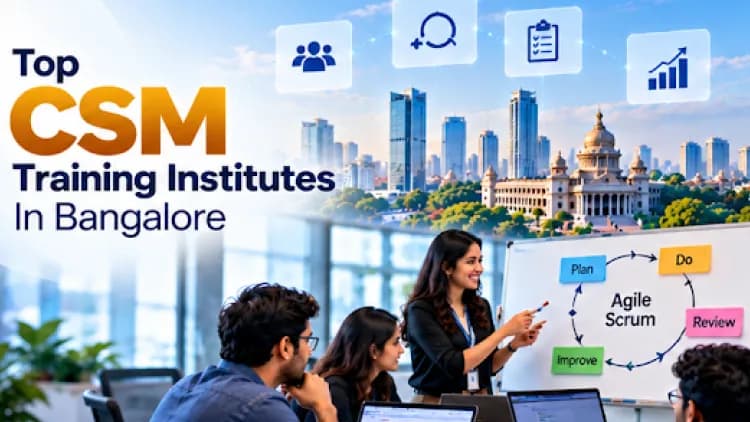


Choosing a Certified ScrumMaster course is less about finding the longest training brochure and more about understanding how the course prepares you to work with a Scrum Team. For professionals searching for a CSM training institute in Bangalore, the useful questions are different from those asked when comparing a general Agile course. You need to look at the Scrum curriculum, trainer credentials, practical activities, certification process and delivery format.
Certified ScrumMaster (CSM) is a Scrum Alliance certification designed to introduce learners to the Scrum framework, including Scrum accountabilities, events, artifacts and practical application. Scrum Alliance currently states that there are no prerequisites for the CSM course, but candidates must complete the required training with an appropriate Certified Scrum Trainer before accessing the certification test.
Bangalore has several providers offering CSM preparation through live online and classroom formats. The following list brings together providers with relevant CSM offerings and compares them by the areas that matter when selecting a course. The numbering is for easier reading and does not represent an independently verified ranking.
What to examine before choosing a CSM course
A CSM course should teach more than Scrum terminology. Scrum Alliance describes the certification learning around the Scrum framework, team accountabilities, events, artifacts and applying Scrum. The official CSM pathway requires at least 16 hours of training.
That means a useful course comparison should begin with the curriculum. Check whether the training explains the responsibilities of the ScrumMaster, Product Owner and Developers, as well as Sprint Planning, Daily Scrum, Sprint Review, Sprint Retrospective, Product Backlog and Sprint Backlog.
The trainer is another important factor. Scrum Alliance states that CSM courses are taught by Certified Scrum Trainers or Certified Scrum Alliance Trainers. Its trainer-search resources allow learners to review trainer backgrounds, courses, schedules and areas of expertise.
Practical learning also deserves attention. Scrum is easier to understand when learners participate in activities, simulations, discussions and team exercises rather than simply reading definitions.
10 CSM Training Institutes to Consider in Bangalore
1. SkillDeck

SkillDeck’s Bangalore CSM page is positioned around comparing Certified ScrumMaster training providers rather than functioning solely as a traditional training institute. Its published course information highlights a two-day training and certification pathway, blended learning, hands-on Scrum and Agile training, Sprint Planning, Daily Scrum, retrospectives, Scrum roles, backlog management and user-story refinement.
The page also presents practical Scrum implementation, Agile facilitation and team collaboration as part of the learning focus. This gives learners several criteria to consider when comparing CSM programs rather than looking at course titles alone.
For someone at the research stage, SkillDeck can be useful for understanding the differences between CSM training options and the types of practical elements to look for before enrollment.
Explore Detailed Comparison of CSM Training Institutes in Bangalore.
2. NevoLearn

Nevolearn offers a CSM certification training program in Bangalore with a broad combination of certification preparation and practical Scrum learning. Its course page describes 16 hours of live training, instruction from Certified Scrum Trainers, exam-fee inclusion and Scrum Alliance membership.
The curriculum covers Scrum roles, events, artifacts, Sprint Planning, Daily Scrum, Sprint Review, Sprint Retrospective, Product Backlog, Sprint Backlog and Definition of Done. The provider also highlights interactive exercises, discussions, simulations, real-world case studies and group activities.
For learners looking for several components within one program, NevoLearn combines live instruction, practical exercises, certification preparation and post-training certification steps. Its page also states that the course can be attended without formal prerequisites.
3. Invensis Learning

Invensis Learning provides CSM certification training in Bangalore through instructor-led formats. Its published program is built around a 16-hour CSM course delivered by Scrum Alliance-certified trainers.
The course focuses on understanding Scrum principles and developing the skills needed to work as a ScrumMaster. The provider lists online training and also presents Bangalore-specific course scheduling.
This option can be considered by learners who want a structured certification course with a defined training duration and trainer-led delivery.
4. Simpliaxis

Simpliaxis offers CSM certification training in Bangalore with live training and certification-focused preparation. Its course page highlights instructor-led sessions, Certified Scrum Trainer involvement, practice examinations, quizzes and an interview toolkit.
The provider also describes Scrum Alliance membership and exam-related inclusions as part of its program. Learners comparing packages should check exactly what is included in the selected batch and whether the current course listing matches their preferred schedule.
5. iCertGlobal

iCertGlobal's Bangalore CSM program is presented as a 16-hour live intensive workshop available through classroom and online formats. The provider states that the course is taught by an official Certified Scrum Trainer and includes CSM examination support.
Its learning emphasis includes servant leadership, facilitation and practical Scrum application. These areas are particularly relevant for learners who want to understand the ScrumMaster's responsibilities beyond simply memorizing framework terminology.
6. KnowledgeHut

KnowledgeHut provides CSM certification training in Bangalore with 16 hours of live instructor-led learning. Its course page highlights practice exams and real-world simulations and activities.
The course is also associated with Scrum Alliance's education ecosystem. For learners comparing training providers, the combination of live instruction and simulation-based learning provides a useful basis for evaluating how much practical participation is included.
7. PremierAgile

PremierAgile offers CSM training in Bangalore based on the learning objectives associated with the Scrum Alliance certification. Its course description covers the Agile Manifesto, Scrum accountabilities, events and artifacts.
The provider describes its sessions as experiential and includes industry-relevant simulations. Its published certification process explains the training, assessment and Scrum Alliance account setup steps, making the course relevant for learners who want the certification pathway explained alongside the classroom learning.
8. Simplilearn

Simplilearn provides CSM certification training in Bangalore with a focus on instructor-led learning and practical Scrum activities. Its course page highlights workshops, team-based activities, case studies, mock tests and question-bank access.
The provider also describes mentorship and Scrum Alliance Registered Education Ally status. For prospective learners, the main point to compare is how these practice activities are incorporated into the actual training schedule.
9. LeanWisdom

LeanWisdom's Bangalore CSM program combines live instructor-led training with Scrum learning and certification preparation. Its published course details include 16 hours of training, Scrum Alliance membership and exam preparation.
The program also emphasizes real-time Scrum activities and simulations. This makes it relevant for learners who prefer an activity-based approach rather than a course built entirely around presentations and theoretical explanations.
10. FITA Academy

FITA Academy offers Scrum Master training in Bangalore covering Agile fundamentals, the Scrum framework, Scrum roles, events, artifacts and Sprint-related practices. Its course page also describes weekday and weekend scheduling options.
The curriculum discusses areas such as Sprint Review, Daily Scrum, Product Backlog, Sprint Retrospective and Definition of Done. Learners should verify the current certification pathway and trainer credentials before enrolling, particularly if their primary goal is the official Scrum Alliance CSM credential.
A quick way to compare the Bangalore options
Provider | Main CSM Emphasis | Training Format |
SkillDeck | Scrum practice and provider comparison | Blended |
NevoLearn | Certification, simulations and Scrum skills | Live / Physical |
Invensis Learning | Structured CSM certification | Online / Classroom |
Simpliaxis | Certification and exam preparation | Live |
iCertGlobal | Facilitation and servant leadership | Classroom / Online |
KnowledgeHut | Live training and Scrum simulations | Live |
PremierAgile | Scrum framework and experiential learning | Online / In-person |
Simplilearn | Activities, case studies and exam practice | Live |
LeanWisdom | Scrum simulations and certification preparation | Live |
FITA Academy | Scrum framework and Agile fundamentals | Weekday / Weekend |
The table is intended as a starting point rather than a ranking. Course schedules, trainer availability and package inclusions can change, so the provider's current course page should be checked before registration.
Understand the CSM learning path before enrolling
One advantage of checking the certification process beforehand is that it prevents confusion between a general Scrum course and an official CSM pathway.
According to Scrum Alliance, candidates seeking the CSM credential must complete the required 16-hour CSM course with a Certified Scrum Trainer. After training, the learner receives access to the online assessment. Prior experience or another Agile certification does not replace the required CSM course.
This distinction matters when comparing training advertisements. A course may use the words “Scrum Master training” while offering a different certification or simply providing general Agile education. If the goal is specifically CSM certification, confirm that the course appears in the appropriate Scrum Alliance course listings and that the trainer meets the required designation.
Skills worth practising during CSM training
A CSM course becomes more useful when learners can connect Scrum theory to situations that occur inside an actual team.
One area is facilitation. ScrumMasters need to understand how to support Scrum events without turning them into conventional status meetings. Another is impediment management, where the learner needs to distinguish between an issue that requires immediate attention and a problem that the team can resolve independently.
Backlog understanding is equally important. A learner should become comfortable discussing Product Backlog items, Sprint Goals, Sprint Backlogs and the Definition of Done.
Conflict handling and servant leadership should also appear in practical discussions. For example, a course may use a scenario where stakeholders want additional work during a Sprint or where team members disagree about how to approach an impediment. Working through such situations gives more context than memorizing Scrum definitions.
Classroom or online CSM training: which format fits?
Bangalore learners have several delivery choices. Classroom training can provide direct interaction and physical group activities, while live online programs can remove travel time and make the course easier to attend from home or the workplace.
The better comparison is not simply classroom versus online. Check whether the format allows meaningful trainer interaction, breakout activities, questions, simulations and practice. A highly interactive online class may provide more useful participation than a classroom course that relies heavily on presentations.
Also consider your working schedule. A two-day intensive course may suit someone who wants concentrated learning, while another learner may prefer a schedule that spreads preparation across several sessions.
Questions to ask before booking your CSM course
Before paying a training fee, confirm these points directly with the provider:
Is the course an official Scrum Alliance CSM pathway?
Is the trainer a Certified Scrum Trainer or other approved trainer for the course?
Does the course meet the required 16-hour training duration?
Are practical Scrum activities included?
Is the certification examination included in the package?
What learning material or practice resources are provided?
Is the training classroom, live online or both?
What happens after the training if you need clarification about the assessment?
These questions can reveal differences between apparently similar courses.
Use your CSM course to practise, not just prepare
The strongest preparation does not end when the training session finishes. After each class, take one Scrum concept and connect it with a situation from a real or hypothetical project.
For example, instead of simply memorizing the purpose of a Sprint Retrospective, consider how you would facilitate one when the team has missed its Sprint Goal. Instead of memorizing ScrumMaster responsibilities, think about how you would respond when a stakeholder repeatedly interrupts the team's Sprint work.
This approach can make the concepts easier to recall during the certification assessment and more useful when you eventually apply them in a Scrum environment.
What to Practise Before and During CSM Training
A CSM course becomes more useful when learners connect Scrum concepts with situations they may encounter in an actual team. Before enrolling, look at whether the training gives enough space to practise activities such as Sprint Planning, Daily Scrum, Sprint Review and Sprint Retrospective rather than only explaining the terminology.
It is also useful to work with simple product backlogs and user stories during training. Learners can observe how priorities change, how a Scrum Master facilitates discussions and how teams identify impediments. These activities make it easier to understand the difference between knowing Scrum terminology and applying the framework in a working environment.
For professionals already working in software or project teams, consider whether the course allows you to relate Scrum practices to your existing responsibilities. A developer may focus on collaboration and Sprint execution, while a project manager or aspiring Scrum Master may pay closer attention to facilitation, team coordination and removing impediments.
Questions to Ask Before Joining a CSM Course
Before paying for a CSM training program, ask the provider a few specific questions:
Who conducts the training, and what is the trainer's certification or professional background?
Is the course aligned with the certification body's current requirements?
How many hours are dedicated to live instruction?
Does the training include Scrum simulations, group activities or case-based exercises?
Is the certification examination process clearly explained?
Are examination fees or certification-related costs included in the course price?
Is the training available online, in person or in both formats?
What learning resources are provided after the live sessions?
Are weekday and weekend schedules available?
What prerequisites, if any, should learners complete before attending?
These questions help separate the actual learning experience from promotional claims and make the comparison more practical.
Make the final CSM choice based on your learning needs
A CSM course can serve different purposes. Someone completely new to Scrum may need more explanation of the framework and accountabilities, while a project professional moving into an Agile environment may be more interested in facilitation, team coaching and practical Scrum situations.
That is why comparing only course fees or training duration can be misleading. Look at the actual learning experience: who teaches the course, what you will practise, how the certification assessment is handled and whether the schedule fits your work commitments.
Build Your CSM Learning Plan
Choosing a CSM training program is only one part of preparing for Scrum practice. Along with comparing course structure and certification requirements, spend time understanding Scrum roles, events, artifacts, facilitation and team collaboration. Reviewing these areas before training can help you participate more actively in exercises and discussions.
For Bangalore learners, the final choice can then be based on practical factors such as trainer-led learning, schedule, delivery format, hands-on activities and the certification pathway. Always verify the latest course and certification details directly with the training provider before enrolling.
Conclusion
Finding a suitable CSM training institute in Bangalore requires more than comparing course names. The important differences are found in trainer credentials, practical Scrum activities, certification support, course structure and how well the delivery format matches your schedule.
SkillDeck and NevoLearn provide broad CSM-focused options with different strengths in how they present learning and certification support, while other providers offer their own combinations of live instruction, simulations, exam preparation and classroom or online delivery.
Before registering, verify the course through the current Scrum Alliance resources and compare the actual learning experience offered by each provider. A thoughtful shortlist can help you select CSM training that supports both the certification process and your understanding of how Scrum works in practice.